• Home
  • Our Story
  • Our Ingredients
  • Contact Us
  • PCE-PRO™
  • DECURSINOL-50
  • More
    • Home
    • Our Story
    • Our Ingredients
    • Contact Us
    • PCE-PRO™
    • DECURSINOL-50
  • Home
  • Our Story
  • Our Ingredients
  • Contact Us
  • PCE-PRO™
  • DECURSINOL-50

SunBio Corporation

SunBio CorporationSunBio CorporationSunBio Corporation

NATURAL INGREDIENTS. BACKED BY SCIENCE.

NATURAL INGREDIENTS. BACKED BY SCIENCE. NATURAL INGREDIENTS. BACKED BY SCIENCE. NATURAL INGREDIENTS. BACKED BY SCIENCE.

PCE-PRO™ | Purple Corn Extract

Close-up of deep purple corn on the cob growing in a green field.

Product Overview

PCE-PRO™ is Sunbio Corporation's flagship ingredient — a standardized purple corn extract delivering clinically validated benefits for both prostate health and eye health. With the highest anthocyanin density of any domestic botanical, PCE-PRO represents a new generation of evidence-based nutraceutical ingredients.


PCE-PRO is derived from the husks and cobs of Zea mays L. — a non-GMO purple corn variety locally bred and cultivated in Korea's Gangwon Province. Its deep purple pigmentation reflects an exceptional concentration of cyanidin-3-O-glucoside (C3G), the primary anthocyanin responsible for its broad-spectrum health benefits.


Manufactured at a KGMP-certified, US FDA-registered facility and standardized to greater than 15% total anthocyanins per batch, PCE-PRO meets the highest quality and consistency standards required for the US supplement market. Korean functional food approval for eye health was received in April 2026.


Prostate Health


PCE-PRO is clinically studied for men's prostate health, with a completed randomized, placebo-controlled human clinical trial demonstrating statistically significant improvements across five key endpoints — including urinary symptom scores, quality of life, bladder emptying, and testosterone maintenance — all without the sexual side effects associated with pharmaceutical alternatives.


Eye Health


PCE-PRO is also clinically studied for dry eye relief, with human RCT data showing statistically significant improvements in the Ocular Surface Disease Index (OSDI), tear film stability (TBUT), and corneal surface protection. Preclinical data further supports applications in eye strain relief and macular protection, making PCE-PRO uniquely positioned across three ocular health indications.


Black corn ears and kernels with dark husks.
Graph and data showing anthocyanin content in various foods, highlighting purple carrot and PCE.

Why PCE-PRO Stands Apart

Most eye health and prostate health ingredients target a single mechanism.  PCE-PRO works across multiple pathways simultaneously — making it uniquely effective and uniquely differentiated in both categories.


Anthocyanin Density — PCE-PRO contains 18,500 mg/kg of anthocyanins — significantly exceeding common sources such as bilberry (~365 mg/kg), elderberry (~300 mg/kg), and blueberry (~150 mg/kg). This exceptional concentration is what drives the breadth and depth of its clinical effects.


Standardization — Every batch is optimized for cyanidin-3-O-glucoside (C3G) — the primary bioactive anthocyanin — ensuring consistent, verified therapeutic potency from batch to batch.


Superior Sourcing — PCE-PRO is extracted from the cob and husk of purple corn, which contain over 10 times more anthocyanins than the kernels used in standard corn-based products.  This is not a commodity corn extract — it is a purpose-bred, registered proprietary variety cultivated specifically for maximum anthocyanin yield.

Dual Indication / One Ingredient — PCE-PRO is the only botanical ingredient with completed human clinical trial data supporting both prostate health and eye health indications — allowing formulators to address two large and growing markets with a single, well-characterized ingredient.

Supply Chain Ready — Manufactured at a KGMP-certified, US FDA-registered facility in South Korea.  Standardized CoA per batch.  Korean functional food approval received in May 2026.  Available exclusively in the US through Sunbio Corporation.


Human Clinical Study Results — Prostate Health

Results from a 12-week, double-blind, randomized, placebo-controlled trial (n=69):


  • IPSS Total Score significantly improved vs. placebo (p=0.049)
  • Quality of Life (QoL) significantly improved vs. placebo (p=0.027)
  • Post-void Residual Urine reduced by 13 mL vs. placebo increase of 1.6 mL (p=0.021)
  • Serum Testosterone maintained vs. decline in placebo group (p=0.028)
  • Sexual function trended favorably across all IIEF subscores — no suppression effect
  • Statistically significant (between-group p-values, PCE vs. placebo)
  • No adverse PSA signal

Clinical Efficacy of PCE-PRO for Ocular Health

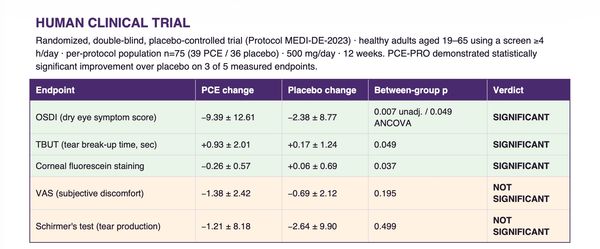
PCE-PRO has been evaluated in a randomized, placebo-controlled parallel group human clinical trial in adults with dry eye symptoms, utilizing a dose of 500 mg/day for 12 weeks.  The trial demonstrated statistically significant improvements across three key ocular endpoints.


Ocular Surface Disease Index (OSDI) — PCE demonstrated a statistically superior reduction in overall dry eye symptom burden compared to the placebo group.  OSDI is the gold-standard measure of how much dry eye disease limits daily activities such as reading, screen use, and driving. p = 0.007


Tear Break-Up Time (TBUT) — PCE significantly improved tear film stability — a core objective marker of tear film health.  Longer TBUT means the tear film stays intact longer between blinks, reducing dryness and ocular surface exposure.  p = 0.049


Corneal Surface Protection — PCE significantly reduced corneal fluorescein staining — an objective, clinician-measured indicator of physical damage to the corneal surface.  Less staining confirms PCE is actively protecting corneal tissue, not only relieving subjective symptoms.  p = 0.037


All p-values reflect between-group comparisons (PCE vs. placebo) — the rigorous standard for RCT efficacy.  Visual Analog Scale (VAS) trended favorably but did not reach statistical significance.  Schirmer's Test showed no significant difference, indicating PCE improves tear film quality rather than tear production volume.

Preclinical Evidence

In vivo dry eye rat model (oral PCE 150 mg/kg vs. omega-3 comparator, 7 days):


  • Tear volume restored to near-normal levels (p<0.0001)
  • Corneal irregularity score reduced from 3.5 to ~1.3 (p<0.0001)
  • Goblet cell density restored dose-dependently (p<0.0001)
  • Apoptotic cells reduced to near-normal (p<0.0001)


Additional animal models support eye strain (retinal blood flow, cGMP) and dry AMD (outer nuclear layer preservation, ERG amplitudes).

Published Studies

Prostate Health


  1. Kim et al. (2022). "Purple Corn Extract Improves Benign Prostatic Hyperplasia by Regulating Prostate Cell Proliferation and Apoptosis." Journal of Agricultural and Food Chemistry, 70, 5561–5569.
  2. Kim, Choi, Lee et al. (2025). "Purple corn extract improves benign prostatic hyperplasia by inhibiting 5 alpha-reductase type 2 and inflammation in testosterone propionate-induced rats." Frontiers in Pharmacology.


Eye Health 


  1. Lee et al. (2023). "Purple Corn Extract Attenuates Dry Eye Disease by Suppressing Inflammation and Oxidative Stress in Corneal and Retinal Epithelial Cells." Nutrients, 15, 5063 (2023).


(Clinical study report for human RCT available upon request — contact thomas@sunbiogroup.com.)


  • PCE-PRO™
  • DECURSINOL-50

These statements have not been evaluated by the Food and Drug Administration. These products are not intended to diagnose, treat, cure or prevent any disease. This information is furnished without warranty, representation, inducement or license of any kind. You are responsible for determining if these products are appropriate for your use.

Copyright © 2026 Sunbio Corporation - All Rights Reserved.

Powered by